Tuesday, October 14, 2014

The Muppets

  • Attack of the English Teacher: 8
    • It's easy to navigate, it looks pleasing, but it's not regularly used for blogging purposes.
  • Riding a Turtle: 8
    • It's eye-catching but also not regularly used.
  • Unconventional English: 7
    • It is VERY intriguing at first glance but not being able to just scroll through the posts is inconvenient.
  • FRCC Writers Blog: 7
    • It's easy to navigate but some of the posts lack in some way or another and the color scheme is off-setting.
  • Drunk Writer Talk 121: 5
    • The attempt  to make the blog look original is nice but the layout is poor. It is difficult to read without something behind the posts and the font choice was not effective.
  • Eng 1 Blogger: 5
    • The blog looks boring and lacks visual stimulation but it's readable.
By: Sierra Baumann, Sydney Evans, Ben Weakland, Ahnun Brainerd, Connor Hicks

Thursday, October 9, 2014

Evaluating Internet Sources Part 1

Tales of Symphonia Chronicles
IGN is a site mostly for video games and a little bit for other geeky things like superhero shows and the like. Even the advertizements are for video games. It's home page shows articles on popular games like Halo and Borderlands. It seems like a site where gamers mostly can find information on games that are out or will be coming out. 

IGN clearly labels authors as well as sponsors. All of the information this site presents is clearly relevant to the purpose of the site itself: to inform about games (mostly). The authors themselves, though, are experts in their own opinions. For reviews, authors play the games to state their opinion about the game and attempt to support their opinions with information they collected about the games. There doesn't seem to really be any outside references besides the physical games themselves. When an article talks about a game, on the left-hand side of the screen is a small blurb about the game with a link to the game description and other informative information like walkthroughs, weapons, achievements, and so on. This site is used regularly by many and is updated with information constantly. Depending on the author, the content, and what type of article you read, different information will be covered in varying depths. The most determining factor of the depth of the article is the authors take on the purpose of their writing.

An example of this is Kallie Plagge's Tales of Symphonia Chronicles Review

This review goes over only a few points of the re-release of the two games included. Kallie has mostly raves about the first of the two games, Tales of Symphonia, stating, "It’s a decade old and certainly feels that way at times, but it has a charm that extends beyond nostalgia." She comments on a new option for the voice-overs, the battle style, and the inconsistent graphics update. She makes a point of stating how great the Tales of Symphonia game is in comparison to its sequel Tales of Symphonia: Dawn of the New World that is also included in the Chronicles package. She clearly feels that the original of the two is superior to the sequel and gives opinions of in-game information to back up her arguments.

Kallie accomplishes her goal of reviewing something that has already been released to the public years before, focusing instead on the differences of the re-release vs the original and the two games themselves. Unfortunately, to someone who hasn't played or read up on either of these games, this review wouldn't make much sense.

By Sierra Baumann

Plagge, Kallie. "Tales of Symphonia Chronicles Review - IGN." IGN. IGN Entertainment, 20 Feb. 2014. Web. 09 Oct. 2014.

Thursday, October 2, 2014

Argument Beyond Pro and Con

After reading issue 4 of this graphic novel I realized how interesting argumentation essay can really be. The comic book layout made it easier to read, and makes readers want to keep reading to find out what would happen next. Although this was an informative (educational) piece, the author was very successful in keeping the reader entertained. I found it very intriguing that the author used well known fact and books that each reader can recognize, such as the three bears in Goldilocks. Not only did they get their point across about argumentation pieces, but gave the reader common ground to relate to. Throughout the piece I found myself connecting previous knowledge to the new information I learned, making this piece quite successful in teaching about argumentation essays.

A graphic novel was a fantastic idea for this author to use in order to teach as well as entertain their reader. They not only made it relateable and interesting, but also gave some step-by-step processes to go through in order for the reader to understand how to use this information in their own writing. The author also knew the right times to crack a joke or to add in an educational piece, such as the essay by Marissa Osato. By understand when and where to place certain pieces the author walked the reader through the steps to create a well-written essay, but also kept them wanting to read and learn more. All students should read this graphic novel and learn new ways to write argumentation essays, and see what they have been doing right and what they could do better. They will learn more from this piece because of how engaging it will make them, and how informative it really is.


 By: Sydney Evans


Finding Fallicies Through Friendship!

Just because something is normal for you doesn't mean that the same thing is normal for everybody else. Everybody is different, ranging anywhere from their culture, to their belief systems, or even their personal values. Even words may be perceived differently to each individual due how unique their concept of reality is.

To avoid making this logical fallacy, stay open minded to accepting differences in opinions. Understand that flexibility and utilizing pro's and con's as well as counterarguments help build a better relationship with the reader.

Image Courtesy of Ami Toben
In Toy Story, Woody and Buzz are from different genres and cultures of toys. Woody, on the one hand, knows for a fact that he is simply a child's toy. Buzz, on the other hand, believes he is the real character his toy was designed for. Woody believes that toys are and can be nothing more than simply toys. Through interaction with Buzz, Woody realized that his logic contained a fallacy, accepting that yes, toys are toys but they can also do great things.

By Sierra Baumann and Sydney Evans

The Art of Argument and Persuasion

Image Courtesy of Lee Odden
The point of an argument or a persuasion essay is to convince the reader of a certain point of view about a certain topic. One of the most important tools in writing an essay of this kind would be Logos, Ethos, and Pathos in the support details. Logos appeals to logic to make a point through facts, statistics, examples, and authoritative statements. Ethos appeals to the author's credibility through means of honesty, integrity, and reliability, which, in turn, creates trust in what the author has to say. Pathos appeals to the reader's emotions of feelings, attitude, values, and beliefs. I had completely forgotten these useful appeals. I consider them to be the most important tools one can use to truly convince their reader of their argument.

For a student, this chapter has many important tools to write an argumentative essay. The chapter outlines the basic pieces of an argument essay and explains WHY each piece is important. It also gives guidelines and strategies for the process of writing an argumentative, persuasive essay.

By Sierra Baumann


Chapter 13 Review
                  I was surprised at how many different parts there really are when writing different types of essays. I was also intrigued by new ways to get across information in an argumentation or persuasive essay like inductive and deductive reasoning as well as how to appeal to a readers emotions at the right time. I also thought it was interesting how this chapter used guideline for how to write an argumentation or persuasion essay. I hadn’t thought about all the different steps that go into a well-written essay, so that was nice for me to read in order to better understand how to correctly write these types of essays.
 -
                  This chapter was aiming to make the reader understand every detail on how to write argumentation and persuasive essays. They take the reader step-by-step through the into, body paragraphs, and conclusion, and then go beyond that in order to give details and examples on what each of these should look like. It also give many examples on types of claims and how to give support for those claims. By giving all these examples and details the reader is able to better understand how these essays are supposed to be written, and how that makes the essay better.
By: Sydney Evans

Wednesday, October 1, 2014

Argumentation: More than Simply 'Pro' and 'Con'

Image Courtesy of Barnes & Noble
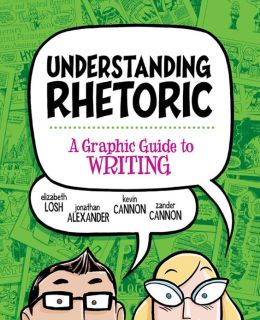
Argumentative essays. We've all written them. In fact, they seem to be the most common of the numeral essay structures English teachers expect us to utilize. Common knowledge of the basic structure of an argument essay is giving pros and cons, the good and bad, to support a thesis argument. Understanding Rhetoric by Elizabeth Losh, Jonathan Alexander, Kevin Cannon, and Zander Cannon brings the basics and some of the finer details of argumentative essays to life with a spunky graphic novel based on informing the reader of rhetoric.

Due to argumentative essays being a popular, basic essay, most of this comic is a review of already known details and important information. The style of the writing and art made educating myself on argument essays rather enjoyable, more enjoyable than it has ever previously been. The issue on argument consists of digging deeper about the concepts of pro's and con's in an essay through everyday situations. It shows arguments, counter arguments, and thought provoking ideas. This issue challenges the reader to go further than simply right or wrong: this issue stresses that there is middle ground between two issues since they are never starkly black and white. The authors even went as far as to use a simile and a visual image of that simile to describe the different pieces of an argument essay and how they fit together.

Image Courtesy of James Arnold
Unfortunately, all of this information is not new news. Although, the emphasis of importance this issue put on common ground between two opposing points is refreshing. To a student who doesn't know the first thing about argumentative essays, this engaging, funny, fast paced visual based interpretation would be a great introduction to the basics and more important aspects of an argumentative essay.

By Sierra Baumann